

A broker It is a licensed company that acts as an intermediary between investors and financial markets. Thanks to a broker you can buy and sell assets such as shares, ETFs, currencies (Forex), raw materials or, depending on the broker and the applicable regulations, other financial instruments.
In other words, A broker is the bridge that connects investors with the markets. Without this intermediary, an individual would not be able to directly access the stock exchanges to carry out operations.
If you want to buy shares of a listed company or invest in an ETF, you will first need to open an account with a broker.
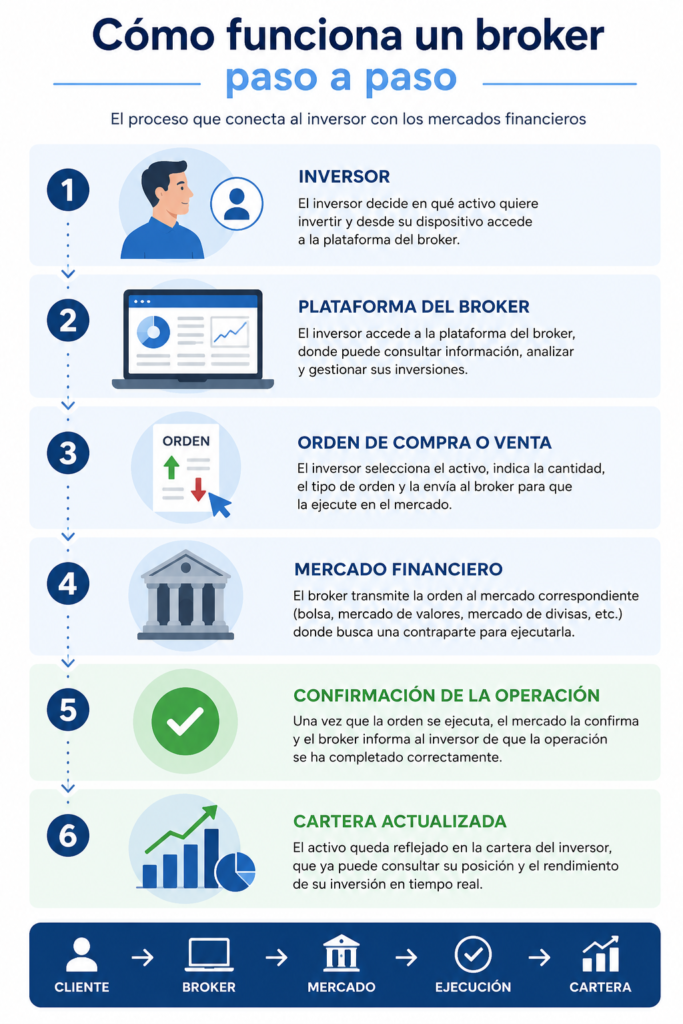
Although it may seem complex, the operation of a broker is quite simple.
When you decide to purchase a financial asset, the process usually follows these steps:
Practical example
Imagine you want to buy shares of a publicly traded company.
You cannot call the exchange directly to make the purchase. You need a broker to receive your order and transmit it to the corresponding market.
The broker acts as an intermediary and facilitates the operation using its technological infrastructure and the access it has to financial markets.
What functions does a broker have?
Although many people think that a broker only serves to buy and sell shares, in reality it offers many more services.
The most common functions are:
Execute buy and sell orders: It is its main function. The broker transmits your orders to the market so that they can be executed.
Give access to different markets:Depending on the broker, you can invest in:
- Actions
- ETFs
- Bonuses
- exchange-traded funds
- Forex
- Raw materials
- Indices
- Cryptocurrencies (when available and in accordance with applicable regulations)
Provide an investment platform: Brokers offer platforms from which you can:
- Check prices in real time.
- Analyze graphs.
- Manage your portfolio.
- Perform operations.
- Follow the evolution of your investments.
Safeguard certain assets and cash:
Many brokers hold their clients' cash and financial instruments in accordance with the regulations that apply to them. The specific conditions depend on the type of broker and the entity with which you open the account.
Provide analysis tools:
Some brokers include:
- Economic calendar.
- Financial news.
- Technical indicators.
- Price alerts.
- Market reports.
Offer training:
More and more brokers incorporate educational resources such as:
- Courses.
- Webinars.
- Videos.
- Guides.
- Demo accounts.
These materials can be useful for those who are starting to invest.
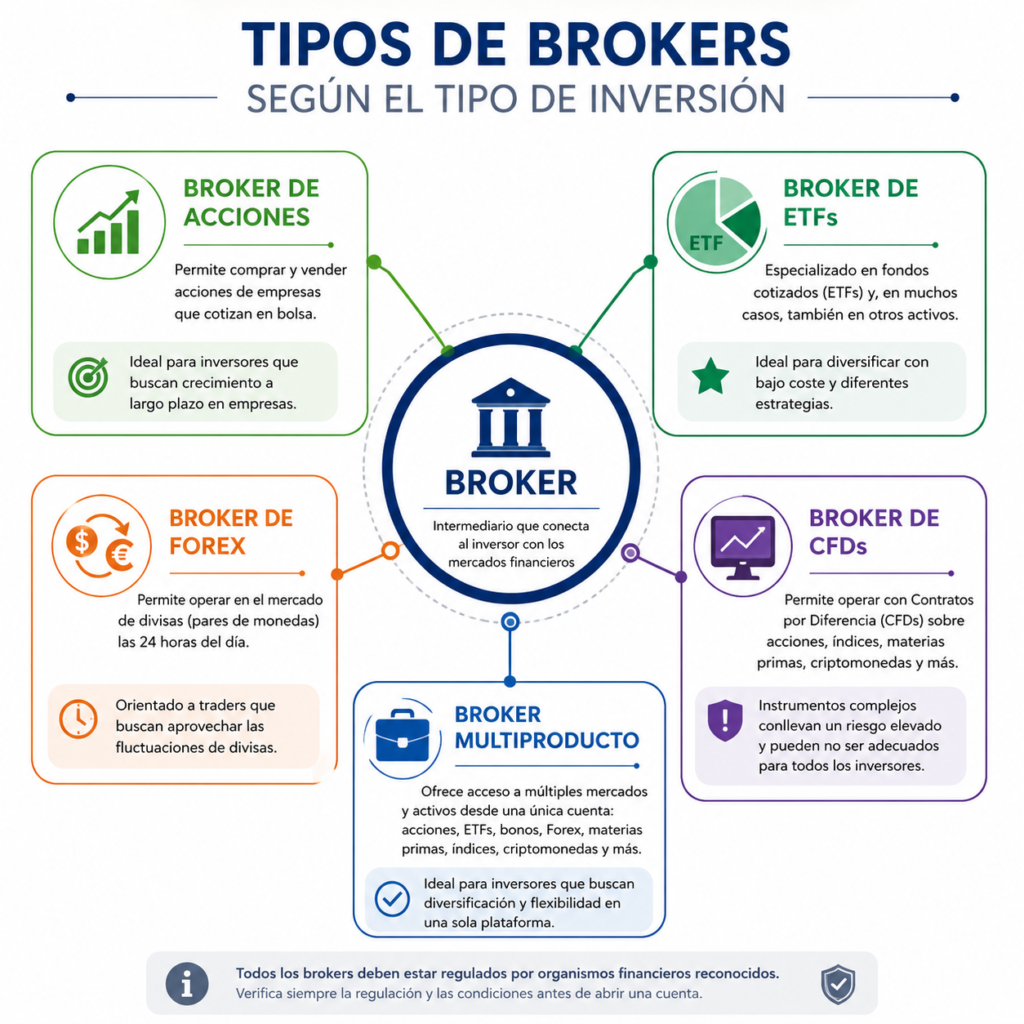
Before opening an account, it is advisable to spend a few minutes checking that the broker meets a series of basic requirements.
Common mistakes when choosing a broker
The most common are:
- Choose the broker solely for the commissions.
- Don't check who regulates it.
- Start investing without using the demo account.
- Do not read the account conditions.
- Choosing a platform that does not suit your investment strategy.